





We’ve entered the era of agentic marketing. Gartner predicts that 40% of enterprise applications will feature task-specific AI agents by 2026, up from less than 5% in 2025. This shift isn’t subtle; it’s seismic. AI-powered is no longer a differentiator. Autonomous execution is the new advantage.
For brands evaluating customer engagement platforms in 2026, the question isn’t “which platform has AI?” Every vendor claims it. The real question is: which platform actually executes autonomously, and which one still requires manual orchestration disguised as AI?
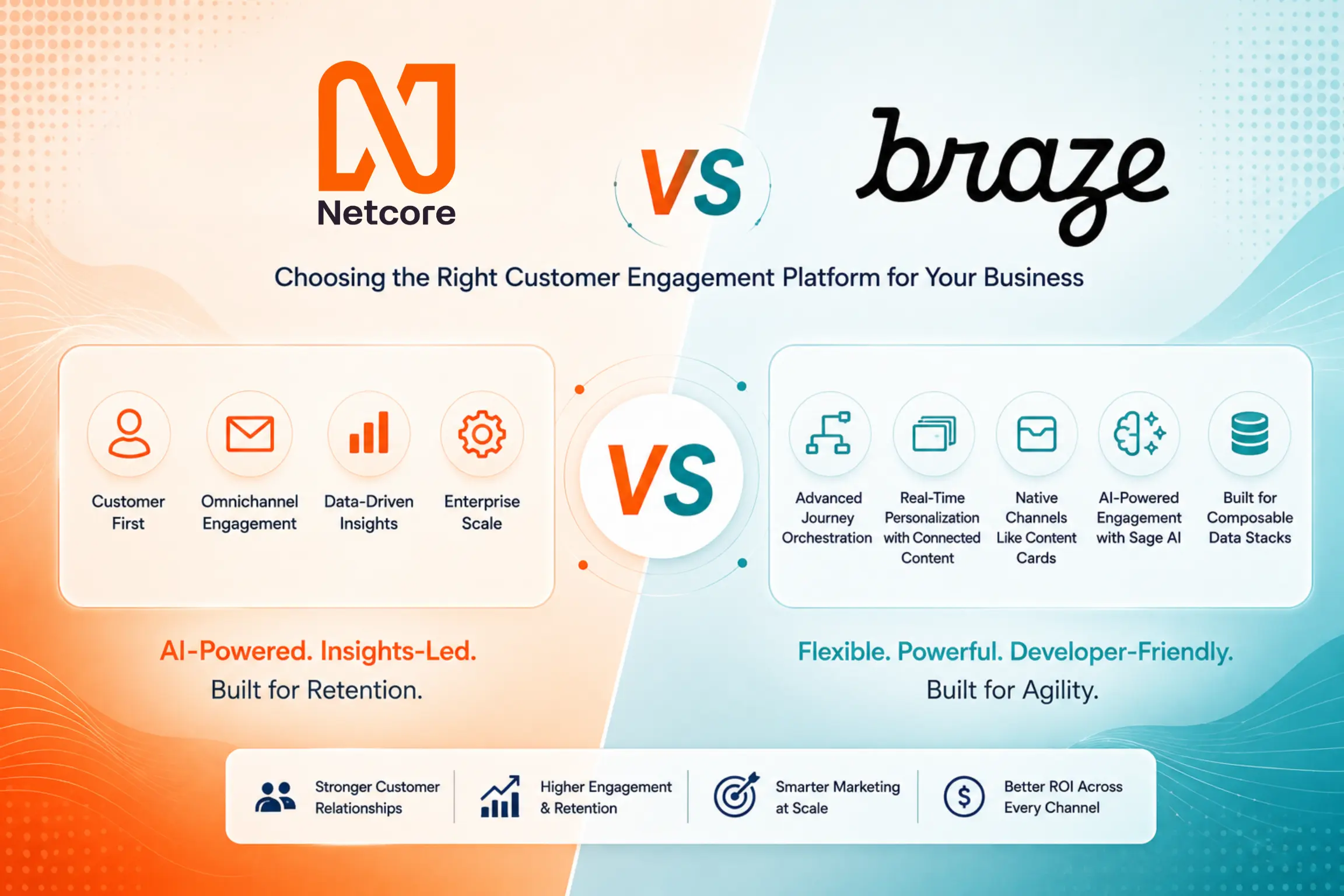
This guide compares two leading platforms, Netcore and Braze, across architecture, capabilities, real-world results, and total cost of ownership. We’ve pulled from verified G2 and Gartner reviews, customer case studies, and head-to-head feature comparisons to help you make an informed decision.
Why This Comparison Matters
Choosing your engagement platform in 2026 isn’t just about features; it’s about positioning your business for where marketing is headed:
- Speed of execution: Can your team activate insights in seconds, or are you stuck waiting for SQL-driven segments?
- AI maturity: Does AI recommend, or does AI execute?
- Channel ownership: Do you own your email infrastructure, or rent it from a third party?
- Marketer autonomy: Can your team operate without engineering dependency?
- Cost predictability: Are you paying for outcomes, or paying for access and hoping for ROI?
A Quick Comparison Table
| Dimension | Netcore | Braze |
|---|---|---|
| Primary Positioning | Full-stack agentic marketing platform with omnichannel engagement + product discovery | Real-time customer engagement platform focused on messaging and journeys |
| Core Strength | AI-led personalization + native channels + product discovery + inbox commerce | Real-time orchestration + API flexibility + strong journey builder |
| Best Fit | Mid-market to enterprise brands focused on ROI and lifecycle growth | High-growth, product-led teams with strong technical resources |
| AI Capabilities | Agentic marketing platform with multi-agent framework. | AI-powered personalization + predictive analytics; limited agentic depth |
| Email Infrastructure | Owned ESP; high deliverability with AMP & interactive email capabilities | Strong infrastructure but not fully owned; less focus on inbox innovation |
| Inbox Commerce | Native AMP emails (forms, carts, bookings inside email) | Not supported natively |
| Product Discovery | AI search, merchandising, and recommendation engine (end-to-end) | Limited; relies on integrations for recommendations |
| Channels | Email, SMS, WhatsApp, RCS, Push, In-App (owned stack) | Email, Push, In-App, SMS; strong but partially dependent |
| Ease of Use | Moderate; marketer-friendly with guided workflows | Steep; requires technical expertise for full utilization |
| Speed to Execution | Fast; campaigns live within days, minimal engineering dependency | Slower; setup and integrations require technical effort |
| Pricing Model | Flexible; usage-based + outcome-based pricing options | Premium enterprise pricing; scales quickly with usage |
| Customer Support | High-touch, KPI-aligned support with dedicated teams | Good enterprise support; varies by plan tier |
| G2 Overall | 4.5 / 5 | 4.5 / 5 |
Netcore Strengths
Netcore’s edge comes from three things most platforms can’t easily replicate: a proprietary email sending infrastructure, AI woven into the agentic marketing platform rather than bolted on, and a genuinely differentiated Inbox Commerce capability.
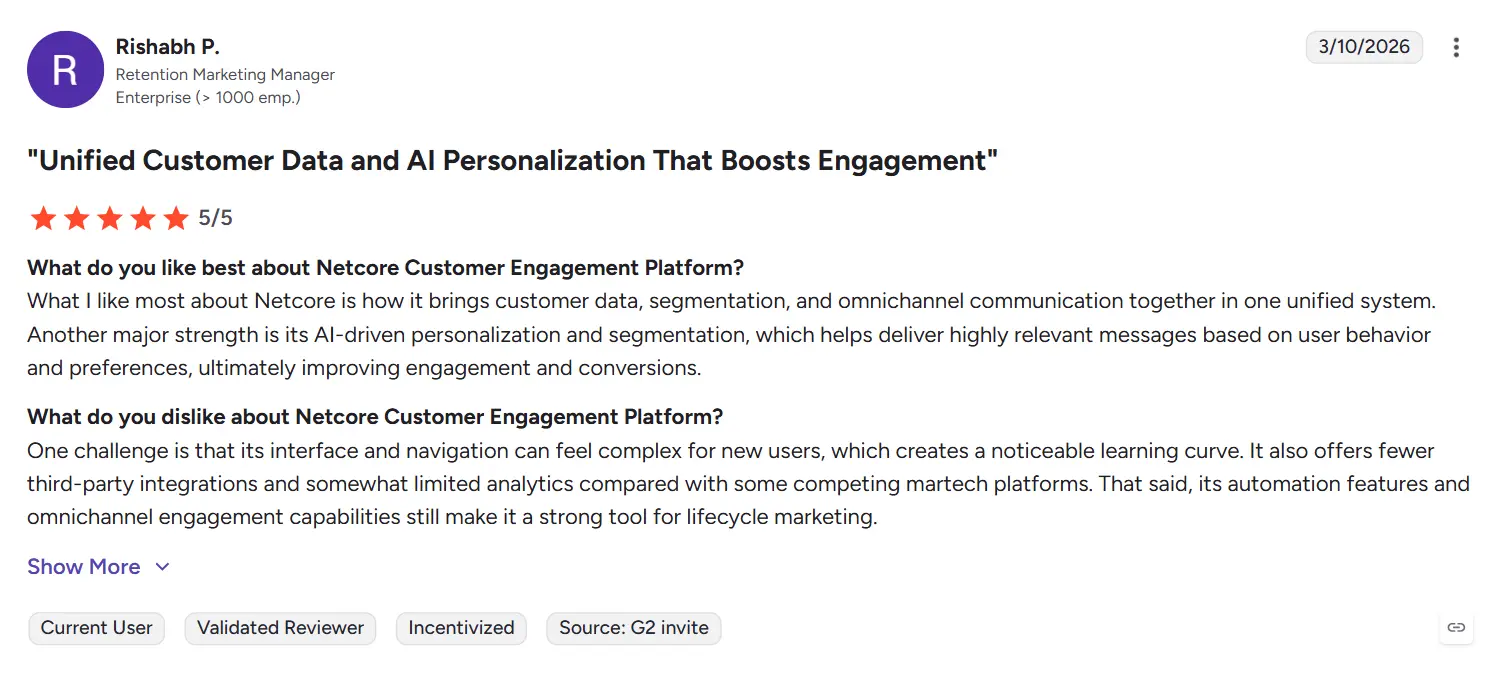
Here’s where Netcore genuinely pulls ahead:
1. Best-in-Class Agentic Marketing Stack
Netcore offers a comprehensive agentic AI layer purpose-built for autonomous marketing. Its specialized agents work together across strategy, decisioning, and execution:
- Insights Agent: Surfaces campaign intelligence in real-time.
- Audience Agent: Auto-refreshing micro-segments.
- Scheduler Agent: Optimizes send-time and channel selection.
- Content Agent: Generates channel-ready creatives.
- Decisioning Agent: Real-time next-best-action orchestration.
- Shopping Agent: Conversational product discovery.
Tying it all together, Co-Marketer helps orchestrate strategy and execution across agents, bringing autonomous, outcome-driven marketing into one coordinated system.
The Shopping Agent alone is delivering remarkable results: 60–70% interaction rate (3x better than search), 40% better refinement, and 12–20% improved add-to-cart rates. As one Director of Ecommerce Operations put it: “The Shopping Agent has been a real game changer for us. It helps bridge the gap between in-store and online experiences, guiding customers, anticipating their next question, and proactively surfacing the right products.”
This is what separates Netcore from competitors, still positioning AI as a recommendation engine. Netcore’s agents don’t just suggest they execute.
2. Netcore’s Inbox Commerce with 95%+ Inbox Placement
Unlike most platforms that rely on third-party email service providers, Netcore owns its sending infrastructure. This means inbox placement, sender reputation, and deliverability are within Netcore’s direct control, not dependent on a vendor they resell.
For high-volume senders, Netcore’s proprietary ESP and AI-driven sending optimization ensures inbox placement of over 95%. SmartPush technology uplifts notification delivery by up to 40% through a 3-stage surgical strike on critical delivery drains.
That’s a material difference if email is a primary revenue channel.
Braze, by contrast, relies on external tools like SendGrid for email deliverability, creating duplicate sends, increased spam risk due to shared infrastructure, and added operational layers. What looks like integration flexibility often carries hidden operational implications.
3. Differentiated Mobile-First Engagement Capabilities
Netcore offers unique mobile-first features like Nudges, a differentiated capability beyond standard in-app pop-ups or triggers common across platforms. Where Braze’s Content Cards face limitations (session load issues, ~30-day default expiry, UI size and customization constraints, and absence of real-time behavioral triggering), Netcore’s nudges adapt inside the product itself.
Netcore’s in-app advantages:
- Real-time behavior-triggered nudges
- Interactive, contextual walkthroughs
- Action-oriented prompts that improve feature discoverability
- Highlight trending products, specific offers, or personalized recommendations
For brands focused on mobile engagement, these capabilities make Netcore a particularly strong choice for driving contextual interactions, conversions, and retention within the app experience.
Domino’s used Netcore’s in-app walkthroughs to boost sales and improve adoption across registration, product selection, customization, and purchase stages. This is product-led engagement, not just campaign-led messaging.
4. AI-Powered Product Discovery
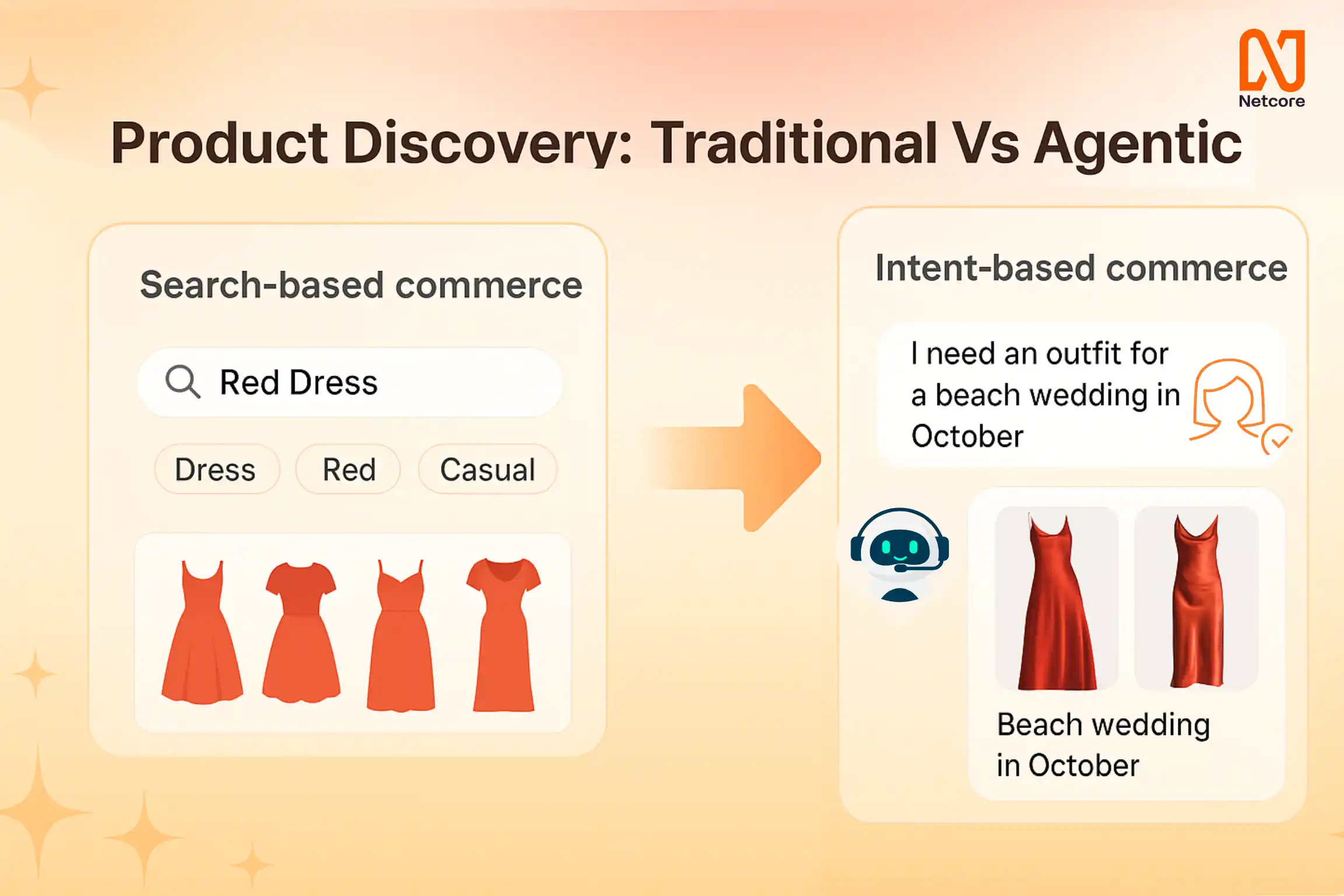
Netcore combines intelligent product discovery with AI-powered product recommendations to influence customer decisions in the moment, helping users discover relevant products, reducing friction in the journey, and driving higher conversions through contextual, behavior-led engagement.
This goes beyond standard segmentation. A large e-commerce retailer leveraged Netcore’s affinity-based category prediction to deliver hyper-personalized product recommendations, resulting in a significant lift in purchase behavior. Oz Hair and Beauty achieved 4x higher click rates and 2x conversion using brand affinity segmentation, moving from 20+ dropdowns to 1 intelligent input.
Braze doesn’t offer this natively. Brands using Braze typically integrate a separate recommendation engine, adding cost and complexity.
5. Native RFM Intelligence with Behavioral Transitions
While Braze requires manual configuration of custom attributes, templates, and SQL-based filters with 60-day duration limits, Netcore offers:
- Automated, real-time RFM updates
- Behavioral transition detection + activation
- Insight-to-Action in one interface
Real use case: Detect users moving from “Loyal” to “At Risk” and trigger personalized win-back campaigns with exclusive discounts, before they churn. Netcore tracks and acts on user transitions between segments in real time. Braze does not natively provide automated RFM transition tracking.
By the time segmentation is done in Braze, the moment is gone.
6. Advanced Analytics & Insights (No External Tools Required)
Netcore separates itself from campaign-centric platforms by providing behavioral analytics natively, not just message performance reports.
Where Netcore wins:
- Funnel Analytics: Drill down by cohorts, RFM, affinity, technographics, and geographics. Compare unique users vs. total conversions. Benchmark across past days, weeks, months, and quarters.
- Cohort Intelligence: 100% native, no exports, no external tools like AppsFlyer or Kubit required.
- User Path Analysis: Visualize real user journeys and remove hidden friction. Available across cross-events with drilldowns (Braze: Limited).
- RFM User Distribution: Built-in user distribution across Recency, Frequency, Monetary dimensions (Braze: Not native).
- Actionable Analytics: Turn funnel, cohort, and RFM analysis into actionable segments and launch campaigns instantly from insight to activation in one platform.
Braze focuses on campaign measurement through control groups and variants. Netcore diagnoses and fixes funnel leakage, not just measures it.
7. Outcome-Based Pricing
Netcore has introduced outcome-based pricing for clients, which ties costs to measurable business results rather than just platform usage. This is a significant trust signal, and a meaningful shift from the “pay for access, figure out ROI yourself” model most platforms still operate on.
8. KPI-Driven Customer Success
Verified Gartner reviewers describe Netcore’s team as “an extension of our own,” helping both on strategy and day-to-day execution. Every client is paired with a Customer Success Manager and Data Scientist working toward defined business outcomes not just resolving support tickets.
This is partnership ownership: co-owned success that aligns fees to KPI outcomes, shares risk, tracks uplift transparently, and rewards measurable value delivered.
Netcore Limitations
Netcore has genuine strengths, but it also has real gaps that buyers in this comparison need to go in with eyes open about.
Where Netcore falls short:
1. Best for Brands Seeking a Unified Platform, Not Multi-Vendor Stacks
Netcore is designed as an integrated ecosystem, bringing together CRM, CDP, messaging infrastructure, product discovery, and agentic marketing in one platform. If your strategy is intentionally built around stitching together multiple point solutions, Netcore’s unified approach may be more comprehensive than what you need.
2. Ideal for Outcome-Driven Teams, Not Brands Seeking a Basic Messaging Tool
If you’re simply looking for a standalone tool to send emails, WhatsApp messages, or run isolated campaigns, Netcore may be more platform than required. It is built for brands looking to drive business KPIs through intelligence-led customer engagement, not just execute campaigns.
3. Works Best When Foundational Data Readiness Is in Place
Netcore delivers the most value when customer events and behavioral data are well-defined. Teams early in their data maturity journey may need to invest upfront in instrumentation and data structuring to accelerate adoption and maximize outcomes.
4. Best Suited for Teams Ready to Evolve Beyond Traditional Martech
Netcore is an agentic marketing platform, not a traditional rules-based martech system. For brands preparing for where marketing is headed in the next few years, however, those AI capabilities become a long-term advantage.
Braze Strengths
Braze remains a credible enterprise platform, particularly in specific scenarios:
1. Strong Journey Orchestration via Canvas
Braze’s Canvas is widely recognized for journey building, particularly for teams with mature workflows. While the next evolution is moving toward fewer manual decisions (where Netcore leads), Braze’s Canvas remains a capable tool for teams comfortable with rule-based orchestration.
2. Established Multi-Channel Messaging at Scale
Braze has invested heavily in multi-channel reliability. Brands sending billions of messages monthly trust Braze’s infrastructure for push notifications and basic multi-channel delivery.
3. Mature Feature Set & Market Validation
Braze has been in the market longer. Its feature depth, customer base, and analyst recognition provide security for risk-averse enterprises that prefer established vendors.
4. Strong Push Notification Capabilities
Braze push notifications are strong and comparable to Netcore in basic capability though there are meaningful differences when you examine real-time behavioral triggers, automation intelligence, and adaptability (where Netcore’s SmartPush pulls ahead with 40% delivery uplift).
Braze Limitations
Based on verified G2 reviews, Gartner Peer Insights, and direct customer migration stories:
1. Manual, SQL-Driven Segmentation
Braze requires manual configuration of custom attributes, templates, and SQL-based filters with 60-day duration limits. Impact: Increased time to market, dependency on technical resources, and delayed activation of behavioral insights.
2. Campaign-Centric Analytics
Braze’s analytics focus on message performance like open rates, click-through rates, campaign conversions; rather than behavioral intelligence. Teams typically need external tools like AppsFlyer or Kubit for advanced cohort reporting and lifecycle analysis.
Funnel drilldowns are limited. Cohort intelligence requires third-party integrations. RFM user distribution isn’t available natively.
3. Content Cards: Static, Not Dynamic
Braze’s Content Cards face structural limitations:
- Session load issues
- Default ~30-day expiry behavior
- Size and customization UI constraints
- Most importantly, pre-built static cards are displayed inside apps/websites that are not dynamically triggered by real-time customer behavior.
This is engagement built into the journey builder, not the product experience.
4. Email Deliverability via Third-Party (SendGrid)
Braze relies on external tools for email deliverability. This creates:
- Duplicate sends
- Increased probability of spam risk due to shared infrastructure
- Increased operational layers
- No direct control over sender reputation
For email-first revenue channels, this is a meaningful structural disadvantage.
5. Predictive Segmentation Requires Manual Setup
Braze requires custom events and attributes for predictive signals. Segmentation by product, category, or brand needs filters and manual setup. Impact: More engineering overhead and slower time-to-value.
6. Limited User Path Analysis
Braze primarily focuses on Canvas journey flows. Exploratory cross-event pathing outside campaigns is limited. Creating actionable segments from behavioral path analysis requires custom event logic or pre-defined segmentation.
7. Lacks Truly Unified, End-to-End Channel Stack
Despite multi-channel positioning, Braze depends on external integrations and tools to deliver a complete experience, creating data silos, analytics gaps, and operational overhead.
Netcore vs Braze Features: A Head-to-Head Comparison
| Capability | Netcore | Braze |
|---|---|---|
| Agentic AI Stack | 6 specialized agents + Co-Marketer (executes autonomously) | Assistive AI (recommends; humans execute) |
| Email Infrastructure | Proprietary ESP, 95%+ inbox placement | Third-party (SendGrid), variable placement |
| RFM Intelligence | Native + automated transitions | Manual SQL-driven, 60-day limits |
| Predictive Segmentation | Out-of-the-box, 1-click activation | Requires custom events & attributes |
| Funnel Analytics | Deep drill-downs (RFM, affinity, technographics) with user & conversion filters | Campaign-centric; limited drilldowns |
| Cohort Intelligence | 100% native, no exports required | Requires AppsFlyer, Kubit, or third-party tools |
| User Path Analysis | Cross-event visualization with actionable segments | Limited; Canvas-focused only |
| In-App Engagement | Real-time behavioral nudges + walkthroughs | Static Content Cards with expiry issues |
| Web Engagement | Pop-ups, sticky bars, banners, forms (native) | Available via SDK & custom setup |
| Personalization from Analytics | Direct activation from funnels, RFM, cohorts | Indirect; requires predefined segments |
| Push Notification Optimization | SmartPush (up to 40% delivery uplift) | Strong but lacks SmartPush optimization |
| Product Discovery | Native Shopping Agent (3x better than search) | Requires third-party integration |
| Unified Stack | All channels + analytics + AI in one platform | Multi-vendor dependencies |
| Pricing Model | Outcome-based pricing | Volume-based with hidden add-ons |
| Customer Success Model | Dedicated CSM with KPI ownership | Standard support; CSM for enterprise only |
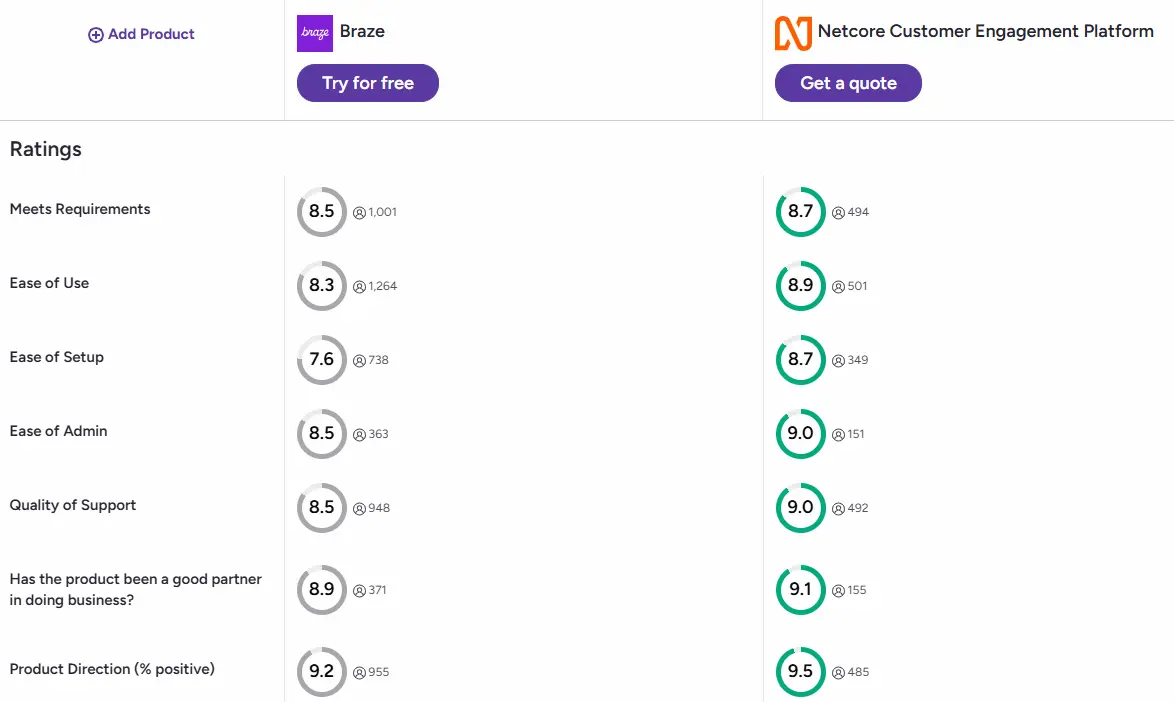
Check what the direct comparison between Netcore and Braze looks like on G2 as rated by real businesses.
Which Platform to Choose?
Choose Netcore if:
- Email is a primary revenue channel, and 95%+ inbox placement directly impacts your bottom line.
- Mobile engagement drives significant revenue, and you need contextual, real-time nudges (not static cards).
- You’re tired of vendor fragmentation and want unified analytics, messaging, personalization, and AI in one platform.
- You need faster time-to-value. Pomelo migrated in just 7 days, achieved 31% increase in conversion rates, and a 5x boost in click-to-order rates.
- You want marketer autonomy, your team is tired of SQL bottlenecks and engineering dependencies.
- Cost predictability is a critical outcome-based pricing that aligns vendor incentives with your results.
- You’re ready for agentic marketing and want autonomous execution, not just recommendations.
- You value a KPI-driven partnership with a CSM + Data Scientist working as an extension of your team.
Real proof from Netcore customers who migrated from or evaluated Braze:
- Pomelo (Retail, SEA): Migrated from Braze in 7 days. 31% conversion lift, 5x click-to-order boost. Chosen Netcore for intuitiveness, unified email delivery, and proactive partnership.
- Nando’s: Evaluated Braze, chose Netcore. 19% member sales increase, 1.1% visit frequency uplift, 12% recency improvement. Powered by geofence triggers, contextual nudges, automated journeys, and in-house attribution.
- Pepe Jeans (Fashion): 1.8x engagement lift, 12.8x quarterly ROI using RFM, AI, and WhatsApp STO. As Sr. Manager Ecommerce, Ashutosh Patkar shared: Partnering with Netcore helped us move from broad targeting to precision marketing… higher conversions, better engagement, and smarter campaign efficiency month after month.
- Amaro (Fashion): Migrated to Netcore for an efficient tech platform.
- Oz Hair and Beauty: Achieved 4x higher click rates and 2x conversion through brand affinity segmentation.
- Domino’s: Boosted sales and improved adoption through Netcore’s in-app walkthroughs.
Choose Braze if:
- You’re an ultra-high-volume sender (10B+ monthly messages) and value Braze’s battle-tested infrastructure.
- You have mature Canvas workflows already in production and significant migration costs.
- You prefer multi-vendor orchestration, and your strategy is intentionally built around point solutions.
- Your team is comfortable with SQL-driven segmentation and manual journey configuration.
- You have dedicated engineering resources for Liquid templating, custom integrations, and external analytics tools.
- You don’t prioritize email deliverability as a revenue driver (push or in-app are your primary channels).
Why Choose Netcore Over Braze?
- Deeper behavioral analytics: Netcore combines campaign-centric and behavioral intelligence funnels with cohort, RFM, affinity, technographic, and geographic analysis, helping marketers identify exactly where users drop off and create re-engagement audiences instantly.
- Insights to activation in one platform: Turn funnel, cohort, RFM, and path analysis into actionable customer segments and launch campaigns without relying on custom event logic or external analytics tools.
- Advanced behavioral path exploration: Visualize user journeys across events, uncover retention and churn trends, and build segments directly from behavioral path analysis for faster campaign execution.
- Behavior-driven personalization: Netcore powers real-time personalization using behavioral signals, affinities, and predictive insights, not just user attributes, enabling more relevant engagement across every touchpoint.
- Native email infrastructure: Unlike platforms that rely on external email delivery providers, Netcore owns its email infrastructure, offering greater control over deliverability, AI-powered send-time optimization, adaptive throughput, and built-in email A/B testing.
- Unified omnichannel platform: Netcore brings together Email, SMS, WhatsApp, Push, RCS, in-app messaging, analytics, AI-powered orchestration, and personalization in one platform, providing a single customer view, unified performance reporting, and measurable revenue attribution across channels.
Total Cost of Ownership (TCO)
Braze often requires additional tools for advanced analytics, lifecycle reporting, and email infrastructure, which can increase integration, licensing, and maintenance costs. Netcore consolidates customer engagement, behavioral analytics, AI-powered personalization, Email, SMS, WhatsApp, Push, RCS, and revenue attribution into a single platform. This reduces vendor sprawl, simplifies operations, accelerates implementation, and lowers the overall cost of managing your customer engagement stack while delivering faster time-to-value and stronger ROI.
Why Is Netcore Best for AI-Powered Customer Engagement?
Netcore combines Agentic AI, real-time behavioral intelligence, and omnichannel orchestration to deliver personalized customer experiences at scale. With AI-powered audience segmentation, predictive recommendations, journey optimization, and autonomous marketing agents, brands can engage every customer with the right message, on the right channel, at the right time, driving higher conversions, retention, and revenue.
Migrate to Netcore
Migrate to Netcore with confidence through a zero-disruption onboarding led by dedicated migration specialists and customer success teams. Replace fragmented analytics, personalization, and engagement tools with a unified AI-powered platform that combines Email, SMS, WhatsApp, Push, RCS, in-app messaging, behavioral analytics, and real-time personalization. With built-in deliverability, advanced customer intelligence, and measurable revenue attribution, Netcore helps you simplify operations, accelerate time to value, and drive better marketing outcomes from day one.
Brands that migrated from Braze to Netcore
Pomelo, Amaro, and Flash Coffee for AI-powered customer engagement and advanced behavioral analytics + real-time personalization.
Final Take
The era of agentic marketing is here. With 40% of enterprise applications expected to use AI agents by 2026, the real question isn’t if AI will transform marketing, it’s whether your platform is built for execution or just assistance.
Braze defined the last decade with journey orchestration, but it was built for a world of SQL workflows, third-party infrastructure, and campaign-led execution.
Netcore is built for what’s next. Choose Netcore if you want agentic AI that executes, real-time personalization, owned infrastructure, and outcome-driven growth. Choose Braze if you’re heavily invested in legacy workflows and engineering-led setups.
The real question isn’t which platform has more features; it’s which is built for speed, autonomy, and outcomes.Looking for a platform built for execution, not just assistance? Talk to us.